
 INR
INR


Comparison: "NVMe vs SSD Hosting: Which is Right for Your Business?"
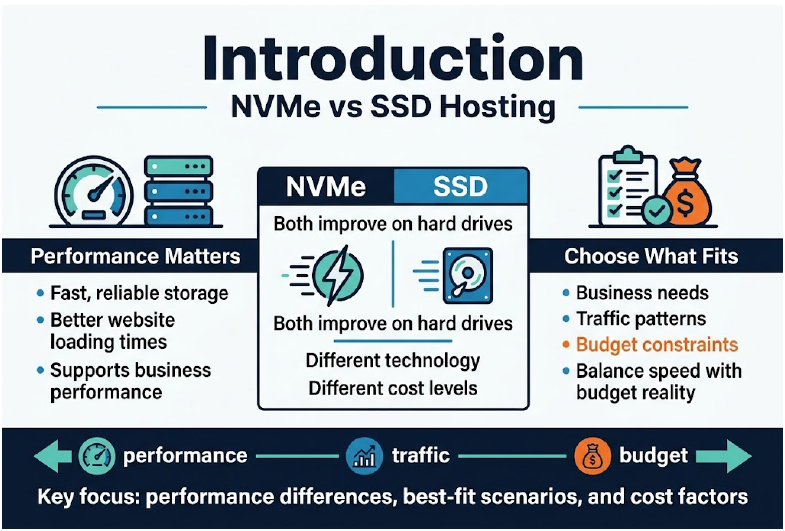
Choosing between NVMe vs SSD hosting can make or break your website's performance and budget. Business owners, IT managers, and developers need fast, reliable storage that won't drain resources or frustrate customers with slow loading times.
NVMe and traditional SSD hosting both offer solid performance upgrades over old-school hard drives, but they work differently and cost different amounts. The right choice depends on your specific business needs, traffic patterns, and budget constraints.
We'll break down the key performance differences between these storage technologies and help you understand which scenarios benefit most from each option. You'll also get a clear picture of the cost factors involved, so you can make a smart decision that balances speed with your budget reality.
Buy our NVMs Server hosting with this https://www.wingshoster.com/vps-hosting
Understanding Storage Technology Fundamentals
What NVMe Technology Delivers for Modern Businesses
NVMe (Non-Volatile Memory Express) represents a revolutionary leap in storage technology designed specifically for the demands of today's digital economy. Unlike older storage protocols that were built for mechanical hard drives decades ago, NVMe was engineered from the ground up to maximize the potential of solid-state storage.
The technology operates directly through the PCIe (Peripheral Component Interconnect Express) lanes on your server's motherboard, creating multiple high-speed pathways for data transfer. This direct connection eliminates the bottlenecks that plague traditional storage interfaces. Where older SATA connections funnel data through a single lane at 6 Gbps, NVMe can utilize up to 32 lanes simultaneously, each capable of transferring data at 32 Gbps.
For businesses running resource-intensive applications like databases, analytics platforms, or high-traffic websites, NVMe delivers measurable performance improvements. Application load times drop significantly, database queries execute faster, and server response times improve dramatically. This translates directly to better user experiences and increased operational efficiency.
The parallel processing capabilities of NVMe also shine during peak traffic periods. When multiple users access your applications simultaneously, traditional storage can create queues and delays. NVMe handles up to 65,536 queues with 65,536 commands each, ensuring smooth performance even under heavy loads.
How Traditional SSD Storage Functions
Traditional SSDs, primarily those using SATA (Serial ATA) interfaces, transformed business computing by replacing mechanical hard drives with flash memory chips. These drives store data in NAND flash cells that retain information without power, making them reliable and energy-efficient compared to spinning disk drives.
SATA SSDs connect to servers through the same interface originally designed for hard disk drives in the early 2000s. This interface uses the AHCI (Advanced Host Controller Interface) protocol, which processes commands sequentially through a single queue. While this approach worked well for mechanical drives with inherent physical limitations, it creates unnecessary constraints for flash storage.
The SATA connection provides a maximum theoretical bandwidth of 6 Gbps, though real-world performance typically peaks around 550 MB/s for reads and writes. For many business applications, this represents a substantial improvement over traditional hard drives, which typically deliver 100-150 MB/s.
Traditional SSDs excel in scenarios where consistent, moderate performance is sufficient. They handle typical business workloads like email servers, basic web hosting, and standard database operations effectively. The technology offers excellent reliability with no moving parts, lower power consumption than mechanical drives, and silent operation.
However, the sequential processing nature of SATA creates performance bottlenecks during intensive operations. When multiple applications request data simultaneously, the single command queue can create delays that impact overall system responsiveness.
Key Technical Differences That Impact Performance
The architectural differences between NVMe and traditional SSD storage create substantial performance variations that directly affect business operations. Understanding these distinctions helps businesses make informed decisions about their hosting infrastructure.
Interface and Protocol Architecture
| Aspect | Traditional SSD (SATA) | NVMe |
|---|---|---|
| Interface | SATA 3.0 | PCIe |
| Protocol | AHCI | NVMe |
| Maximum Bandwidth | 6 Gbps | Up to 128 Gbps (PCIe 4.0 x16) |
| Command Queues | 1 queue, 32 commands | 65,536 queues, 65,536 commands each |
| Latency | ~100-500 microseconds | ~10-20 microseconds |
Data Processing Methods
NVMe processes multiple data requests simultaneously through its parallel queue structure, while SATA handles requests one at a time. This difference becomes critical during database operations, file transfers, or when serving multiple website visitors. NVMe can handle random read/write operations with significantly lower latency, making it ideal for applications requiring rapid data access.
CPU Efficiency
NVMe reduces CPU overhead by streamlining the communication path between storage and processor. Traditional SATA drives require more CPU cycles to manage data transfers, which can impact overall server performance during intensive operations. NVMe's efficient design frees up processor resources for other business-critical tasks.
Scalability Factors
The parallel architecture of NVMe scales better with increasing workloads. As your business grows and data demands increase, NVMe maintains consistent performance levels while SATA may experience degradation during peak usage periods. This scalability makes NVMe particularly valuable for growing businesses that anticipate increased traffic or data processing requirements.
Here is our best Hosting services have a look https://www.wingshoster.com/shared-hosting
Performance Benchmarks and Speed Comparisons
8-12 seconds" "Docker containers start 40-60% faster" "Virtual machine boot times improve by similar margins" Smaller supporting text: "Reports generate faster" "Forms populate faster" "Dashboards refresh faster" Section 4 on the lower left and center: "Database Query Response Improvements" Use a database cylinder icon with query lines and lightning accents. Show a clean bullet list with percentage callouts: "Simple SELECT queries: 15-25% faster" "Complex JOIN operations: 200-300% improvement" "Full-table scans: 400-500% faster" "Index rebuilding: 300-400% reduction in time" Include smaller text: "MySQL and PostgreSQL databases" "Nightly backups complete faster" "Reduced maintenance window" Section 5 on the lower right: "Website Loading Speed Impact" Use a browser window icon, mobile phone icon, and search ranking arrow. Include exact text callouts: "Time to First Byte (TTFB): 20-50% improvement" "Page load times: 2-3 seconds -> 1-1.5 seconds" "Mobile users benefit even more" "Better Core Web Vitals" "Improved SEO performance" "Increased organic traffic" Use clean section dividers, subtle glow effects around NVMe elements, and simple comparison arrows between SATA and NVMe. Emphasize NVMe in bright blue and SATA in muted gray. Place the title at the top, comparison charts in the upper half, application and database sections in the lower half, and website/SEO callouts in a right-side block. No photo realism, no 3D mockup, no clutter, no vertical poster stack." class="w-full"/>Data Transfer Rates and Real-World Applications
The raw numbers tell only part of the story when comparing NVMe and traditional SSD hosting. NVMe drives typically achieve sequential read speeds of 3,500-7,000 MB/s, while standard SATA SSDs max out around 550 MB/s. That's roughly 6-13 times faster on paper, but real-world performance depends heavily on your specific applications.
For file transfers and backups, NVMe shines brightest. Moving large video files, database exports, or system images happens noticeably faster. A 10GB backup that takes 18 seconds on NVMe might require 3 minutes on traditional SSD storage.
Random read/write operations show even more dramatic improvements. NVMe handles small file operations at 600,000+ IOPS compared to 100,000 IOPS for SATA SSDs. This difference matters most for applications that constantly access many small files or perform frequent database operations.
| Storage Type | Sequential Read | Sequential Write | Random Read IOPS | Random Write IOPS |
|---|---|---|---|---|
| SATA SSD | 550 MB/s | 520 MB/s | 100,000 | 90,000 |
| NVMe SSD | 3,500 MB/s | 3,000 MB/s | 600,000 | 550,000 |
Loading Times for Business-Critical Applications
Application launch times shrink dramatically with NVMe hosting. Complex business software like ERP systems, CRM platforms, and accounting applications benefit from faster storage access patterns. What once took 30-45 seconds to fully load might drop to 8-12 seconds.
The improvement extends beyond initial loading. Applications that frequently access configuration files, templates, or cached data maintain their responsiveness throughout usage. Users spend less time waiting for reports to generate, forms to populate, or dashboards to refresh.
Virtual machines and containerized applications see particularly impressive gains. Docker containers start 40-60% faster on NVMe storage, while virtual machine boot times often improve by similar margins. For businesses running multiple virtualized workloads, these seconds add up to meaningful productivity gains.
Database Query Response Improvements
Database performance transforms with NVMe storage, especially for workloads involving complex queries across large datasets. MySQL and PostgreSQL databases show 2-4x improvement in query execution times for operations requiring multiple table joins or full-text searches.
The impact becomes most apparent during peak usage periods. Traditional SSD hosting might struggle with concurrent database connections, leading to query timeouts or sluggish response times. NVMe maintains consistent performance even under heavy load.
Consider these typical improvements:
Simple SELECT queries: 15-25% faster
Complex JOIN operations: 200-300% improvement
Full-table scans: 400-500% faster
Index rebuilding: 300-400% reduction in time
Database backup and restoration operations also benefit significantly. Nightly backups complete faster, reducing the maintenance window and minimizing performance impact on production systems.
Website Loading Speed Impact on User Experience
Website performance directly correlates with user satisfaction and conversion rates. NVMe hosting reduces server response times, particularly for dynamic content that requires database queries or file system access.
Time to First Byte (TTFB) improvements range from 20-50%, depending on website complexity. E-commerce sites with product catalogs, image galleries, and user-generated content see the most dramatic improvements. Page load times that previously averaged 2-3 seconds often drop to 1-1.5 seconds.
Mobile users benefit even more from these improvements. Slower mobile networks amplify the importance of fast server response times. Every millisecond saved on the server side translates to better mobile user experience.
Search engine optimization also improves with faster hosting. Google's Core Web Vitals metrics reward faster-loading sites with better search rankings. The server response time improvements from NVMe storage directly contribute to better SEO performance and increased organic traffic.
Cost Analysis and Budget Considerations
Initial Investment Requirements for Each Technology
Traditional SSD hosting typically demands lower upfront costs, making it accessible for businesses with tight budgets. Standard SATA SSDs range from $50 to $200 per drive for enterprise-grade solutions, while the hosting plans themselves start around $20-50 monthly for basic configurations.
NVMe hosting commands a premium price point due to cutting-edge technology and superior performance capabilities. Enterprise NVMe drives cost between $150 to $500 per unit, with hosting plans starting at $80-150 monthly for comparable storage capacity. The price gap reflects the advanced PCIe interface and enhanced controller architecture that NVMe technology delivers.
| Storage Type | Drive Cost Range | Monthly Hosting Cost | Setup Fees |
|---|---|---|---|
| Traditional SSD | $50 - $200 | $20 - $50 | $0 - $25 |
| NVMe SSD | $150 - $500 | $80 - $150 | $25 - $100 |
Hardware requirements also differ significantly. NVMe systems need compatible motherboards with M.2 slots or PCIe connections, potentially requiring infrastructure upgrades. Traditional SSDs work with existing SATA connections, reducing compatibility concerns and additional hardware expenses.
Long-Term Operational Cost Benefits
NVMe hosting generates substantial operational savings through improved efficiency and reduced resource consumption. Applications load 3-5 times faster, decreasing server CPU usage and memory requirements. This translates to lower electricity bills and reduced cooling costs in data centers.
Database-heavy applications particularly benefit from NVMe's speed advantages. E-commerce platforms experience faster query processing, reducing server load during peak traffic periods. This efficiency allows businesses to handle more concurrent users without upgrading to higher-tier hosting plans.
Traditional SSD hosting offers predictable operational costs but may require additional resources as applications grow. Slower data access speeds can create bottlenecks, forcing businesses to scale horizontally by adding more servers rather than maximizing single-server performance.
Maintenance costs favor NVMe technology due to fewer moving parts and advanced error correction capabilities. Enterprise NVMe drives typically last 2-3 years longer than traditional SSDs under heavy workloads, reducing replacement frequency and associated downtime costs.
Return on Investment Timeline Comparison
Businesses choosing NVMe hosting typically see ROI within 12-18 months for performance-critical applications. E-commerce websites report 15-25% conversion rate improvements due to faster page load times, directly impacting revenue streams. The initial premium pays for itself through enhanced user experience and increased sales.
Content delivery networks and media streaming services achieve ROI even faster, often within 6-9 months. Reduced buffering times and improved user satisfaction lead to lower churn rates and higher subscription renewals.
Traditional SSD hosting provides steady, predictable returns over 24-36 months. While the performance gains are less dramatic, the lower initial investment makes it suitable for businesses with stable, moderate traffic patterns.
Break-even analysis shows NVMe hosting favors high-traffic websites processing over 10,000 daily visitors or applications requiring frequent database interactions. Traditional SSD hosting remains cost-effective for smaller businesses, blogs, and static websites with limited performance demands.
| ROI Timeline | NVMe Hosting | Traditional SSD |
|---|---|---|
| High-Traffic Sites | 6-12 months | 18-24 months |
| E-commerce Platforms | 12-18 months | 24-36 months |
| Basic Websites | 24-36 months | 12-18 months |
Business Use Case Scenarios
High-Traffic E-commerce Platform Requirements
E-commerce platforms face unique challenges when millions of customers browse, search, and purchase simultaneously. Traditional SSD hosting can handle moderate traffic, but high-volume sites experience bottlenecks during peak shopping periods like Black Friday or flash sales.
NVMe hosting delivers the rapid data retrieval essential for product catalogs, inventory management, and payment processing. When customers search through thousands of products or filter results, NVMe's superior IOPS (Input/Output Operations Per Second) prevents the dreaded loading delays that kill conversions. Database queries execute faster, shopping carts update instantly, and checkout processes remain smooth even under heavy load.
Consider Amazon or Shopify's infrastructure - they rely on lightning-fast storage to maintain user experience across millions of concurrent sessions. A single second of delay can cost major retailers millions in lost sales, making NVMe's premium cost justifiable for high-volume platforms.
| Traffic Level | Recommended Storage | Key Benefits |
|---|---|---|
| 10K+ daily visitors | NVMe | Sub-second page loads, real-time inventory |
| 1K-10K daily visitors | High-performance SSD | Balanced cost-performance |
| <1K daily visitors | Standard SSD | Cost-effective for growth |
Data-Intensive Application Hosting Needs
Applications handling massive datasets - analytics platforms, machine learning workloads, video streaming services - push storage systems to their limits. These scenarios involve constant read/write operations with large file sizes that overwhelm traditional storage interfaces.
NVMe excels in data-intensive environments where applications process terabytes of information daily. Real-time analytics dashboards need instant access to historical data, streaming platforms require seamless video delivery, and ML training algorithms benefit from rapid data loading cycles.
Take Netflix's content delivery system - they need instantaneous access to massive video files across global servers. The difference between NVMe and traditional SSD becomes dramatic when serving 4K content to millions of users simultaneously. Database applications like PostgreSQL or MongoDB see significant performance gains with NVMe, especially during complex queries involving large datasets.
Ideal NVMe Applications:
Big data analytics and business intelligence
Video/audio streaming platforms
Machine learning model training
High-frequency trading systems
Real-time data processing applications
Small Business Website Hosting Considerations
Small businesses face a different equation when choosing between NVMe and SSD hosting. Budget constraints often outweigh performance benefits, especially for websites with modest traffic volumes and simple functionality.
Most small business websites - local services, portfolios, basic e-commerce - perform adequately on quality SSD hosting. A restaurant website displaying menus and contact information doesn't require NVMe's blazing speeds. The cost difference could be better invested in marketing, content creation, or other business growth activities.
However, small businesses planning rapid expansion should consider NVMe as future-proofing. A photography studio starting with a simple portfolio might later add client galleries, online ordering, and resource-heavy features that benefit from superior storage performance.
https://www.wingshoster.com/vps-hosting
SSD Works Well For:
Brochure websites with static content
Small blogs and portfolios
Local business directories
Simple contact/information sites
Consider NVMe When:
Planning significant traffic growth
Adding interactive features or databases
Competing in performance-sensitive markets
Budget allows for premium hosting investment
Enterprise-Level Performance Demands
Enterprise environments operate under strict performance requirements where downtime costs thousands per minute and user experience directly impacts productivity. These organizations typically run multiple applications simultaneously - CRM systems, ERP platforms, communication tools - all requiring consistent, high-speed data access.
NVMe becomes essential for enterprises managing complex workloads across distributed teams. Virtual desktop infrastructure (VDI) environments serving hundreds of remote workers need rapid boot times and seamless application performance. Enterprise databases supporting business-critical operations can't afford the latency associated with traditional storage interfaces.
Large corporations also deal with compliance requirements and data retention policies that demand reliable, fast storage solutions. When auditing systems need instant access to years of transaction data, or when disaster recovery procedures require rapid data restoration, NVMe's performance advantages translate directly to business continuity.
Enterprise NVMe Benefits:
Reduced application load times across multiple systems
Improved virtual machine performance and density
Faster backup and disaster recovery operations
Enhanced user productivity through responsive applications
Better support for concurrent user workloads
Improved database transaction processing speeds
ROI Considerations:
Employee productivity gains from faster systems
Reduced infrastructure requirements due to efficiency
Improved customer satisfaction through better performance
Lower risk of revenue loss from system slowdowns
Reliability and Durability Factors
Mean Time Between Failures Comparison
Traditional SATA SSDs typically achieve MTBF ratings between 1.5 to 2 million hours, which translates to roughly 171-228 years of continuous operation under normal conditions. NVMe drives often push these numbers even higher, with many enterprise-grade models reaching 2.5 to 3 million hours MTBF. The improved reliability comes from advanced controller technology and better error correction algorithms built into modern NVMe drives.
These numbers might seem abstract, but they have real-world implications for your business operations. Higher MTBF ratings mean fewer unexpected drive failures, less emergency replacement costs, and reduced risk of data loss scenarios that could cripple your operations.
| Storage Type | Typical MTBF Range | Real-World Impact |
|---|---|---|
| SATA SSD | 1.5-2 million hours | Good reliability for most applications |
| NVMe SSD | 2-3 million hours | Superior reliability for mission-critical systems |
Data Protection and Recovery Capabilities
NVMe drives come equipped with more sophisticated data protection features compared to traditional SSDs. Advanced error correction codes (ECC), end-to-end data protection, and power loss protection are standard on most enterprise NVMe drives. These features work together to prevent data corruption during unexpected power outages or system crashes.
Traditional SSDs offer solid data protection, but NVMe takes it several steps forward. Many NVMe drives include hardware-based encryption, secure erase capabilities, and advanced wear leveling algorithms that distribute write operations more evenly across the drive. This smart distribution helps prevent premature failure of specific memory cells.
Recovery capabilities also differ significantly. NVMe drives often feature more granular SMART monitoring, providing detailed health metrics that can predict failures before they happen. This predictive capability gives you time to migrate data and replace drives during planned maintenance windows rather than during emergency situations.
Maintenance Requirements and Downtime Risk
Regular SATA SSDs require minimal maintenance beyond standard monitoring and occasional firmware updates. The maintenance burden is generally light, making them suitable for businesses with limited IT resources. However, their slower performance can sometimes mask developing issues until they become critical problems.
NVMe drives actually reduce overall maintenance complexity despite their advanced features. The improved monitoring capabilities mean you can spot potential issues earlier, and the faster data transfer speeds make backup and migration operations much quicker when maintenance is needed. A full drive backup that might take hours with traditional SSDs can often be completed in minutes with NVMe technology.
Downtime risk varies significantly between the two technologies. While both are reliable, NVMe's superior performance means that even during maintenance operations, your systems can often continue operating with minimal impact. The faster read/write speeds also mean quicker recovery times when issues do occur, keeping your business running smoothly even during unexpected problems.
Conclusion
Choosing the right hosting depends on your business needs, website traffic, performance expectations, and budget. Both NVMe and traditional SSD hosting offer major advantages over outdated HDD storage, but they serve different use cases.
NVMe Hosting
- Faster speed and overall performance
- Best for demanding applications and high workloads
- Ideal for large databases and dynamic websites
- Excellent for high-traffic websites and eCommerce stores
- Lower latency and faster response times
- Better scalability for growing businesses
- Higher overall hosting cost
Traditional SSD Hosting
- Reliable and solid everyday performance
- More budget-friendly hosting option
- Works well for small and medium businesses
- Suitable for lighter storage and website needs
- Great for blogs, portfolios, and startup websites
- Lower infrastructure and hosting costs
Smart Move for Businesses
- Evaluate your current website and application requirements
- Consider your future business growth and scalability needs
- Choose NVMe for performance-heavy workloads and SSD for standard hosting needs
Final Recommendation
If your business depends heavily on speed, user experience, and high-performance applications, NVMe hosting is the better long-term investment.
If you need reliable hosting at a lower cost for standard business websites, traditional SSD hosting remains a practical and cost-effective solution.
The good news is that most businesses can upgrade from SSD to NVMe hosting later as traffic and performance demands increase.
When choosing between NVMe and traditional SSD hosting for your business, the decision really comes down to your specific needs and budget. NVMe clearly wins on speed and performance, making it perfect for businesses running demanding applications, handling large databases, or serving high-traffic websites. Traditional SSDs still offer solid performance at a more budget-friendly price point, which works great for smaller businesses or those with less intensive storage requirements.
The smart move is to evaluate what your business actually needs right now and where you're headed in the next few years. If you're dealing with heavy workloads and can justify the extra cost, NVMe hosting will give you that performance edge that keeps customers happy and operations running smoothly. But don't overlook traditional SSD hosting if it meets your current needs – you can always upgrade later as your business grows and demands increase.